Personal map reading guide
How to Read an Astrocartography Map
Learn how to read an astrocartography map by moving from the planet and angle to a real city, a real goal, and the evidence around that place. Generate your own map first, then use this sequence to decide what deserves a closer look.
Generate your personal astrocartography map
Start with the map itself
Before you learn how to read an astrocartography map, know what it shows.
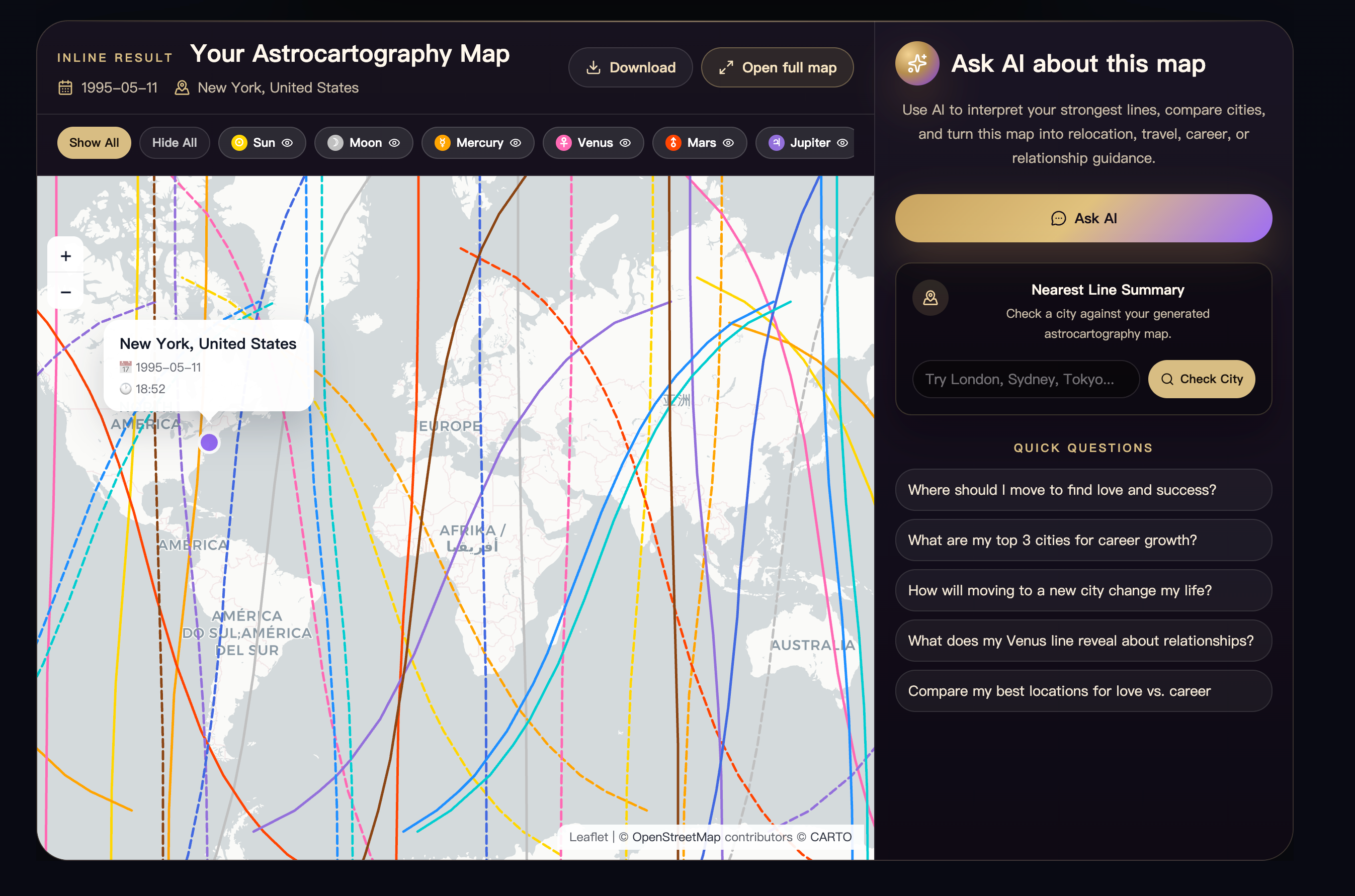
An astrocartography map places the planets from your birth moment on a world map. Each line marks a place where a planet was rising, setting, overhead, or below the horizon. The map is a pattern of possible emphasis; it is not a ranking of cities and it does not remove the need for ordinary research.
What you are looking at
The coloured paths are not independent predictions. A Venus line still needs an angle; a close line still needs a city; and a promising theme still needs a goal. Start by reading the label attached to the line instead of guessing from colour or from how many paths cross a country.
If you are learning how to read an astrocartography map, keep the label, the city, and the question together before you form an interpretation.
This formula gives you a stable way to compare two cities. It also keeps an attractive interpretation from becoming a rushed relocation conclusion.
Review all astrocartography line meaningsA repeatable reading order
How to read an astrocartography map in five passes.
Use the same order whenever a map feels crowded. The first pass identifies the signal; the last pass asks whether it matters for the life decision in front of you. When you need to learn how to read an astrocartography map, this order prevents the brightest line from taking over the whole reading.
Name the planet
The planet gives the subject of the map signal. The Sun points toward visibility and self-definition; Venus toward connection and value; Saturn toward structure and responsibility. Start with the theme, then ask where it appears in your life.
Read the angle
AC, DC, MC, and IC tell you where the planet enters experience. AC concerns identity, DC encounters, MC public direction, and IC home and roots. The same planet can ask a completely different question on another angle.
Check city distance
A line is easier to interpret when you connect it to a real city and its approximate distance. Closer signals deserve closer examination; wider signals can remain background context. Distance is evidence about relevance, not a promise of an event.
Compare the nearby map
One line rarely explains a whole place. Look for another planet, angle, or crossing that supports, complicates, or redirects the first signal. A mixed result is often more useful than a single line labelled good or bad.
Return to your question
Finish with the decision you actually face: a move, a trip, a work project, a relationship, or a search for belonging. The map gives you a question to investigate alongside cost, safety, timing, health, and lived experience.
The same planet changes by angle
How the four angles change what you read on the map.
If two cities sit near the same planet, the angle is often the next useful distinction. It tells you whether the theme is more likely to enter through identity, other people, public direction, or private foundations.
Identity and first moves
An AC line describes how a planet may colour your presence, body, initiative, and way of entering a place. Ask how you introduce yourself there and which part of your identity becomes easier to express.
Relationships and encounters
A DC line moves the planet into partnership, clients, collaboration, and significant others. Ask what people mirror or require from you. Attraction and friction can belong to the same line.
Career and public direction
An MC line brings attention to work, reputation, leadership, and the role other people see you playing. Visibility may open a door while also adding pressure and responsibility.
Home and private foundations
An IC line turns the question inward toward home, family, memory, and belonging. A quieter place can still be significant when your goal is a stable base rather than public recognition.
Do not stop at the world map
Turn a line into evidence about a real city.
A map can show a path, but a decision is usually about a city. After you learn how to read an astrocartography map, the useful bridge is to check the closest visible signals around the place you live, may visit, or are considering. The result should tell you what to investigate next, not decide for you.
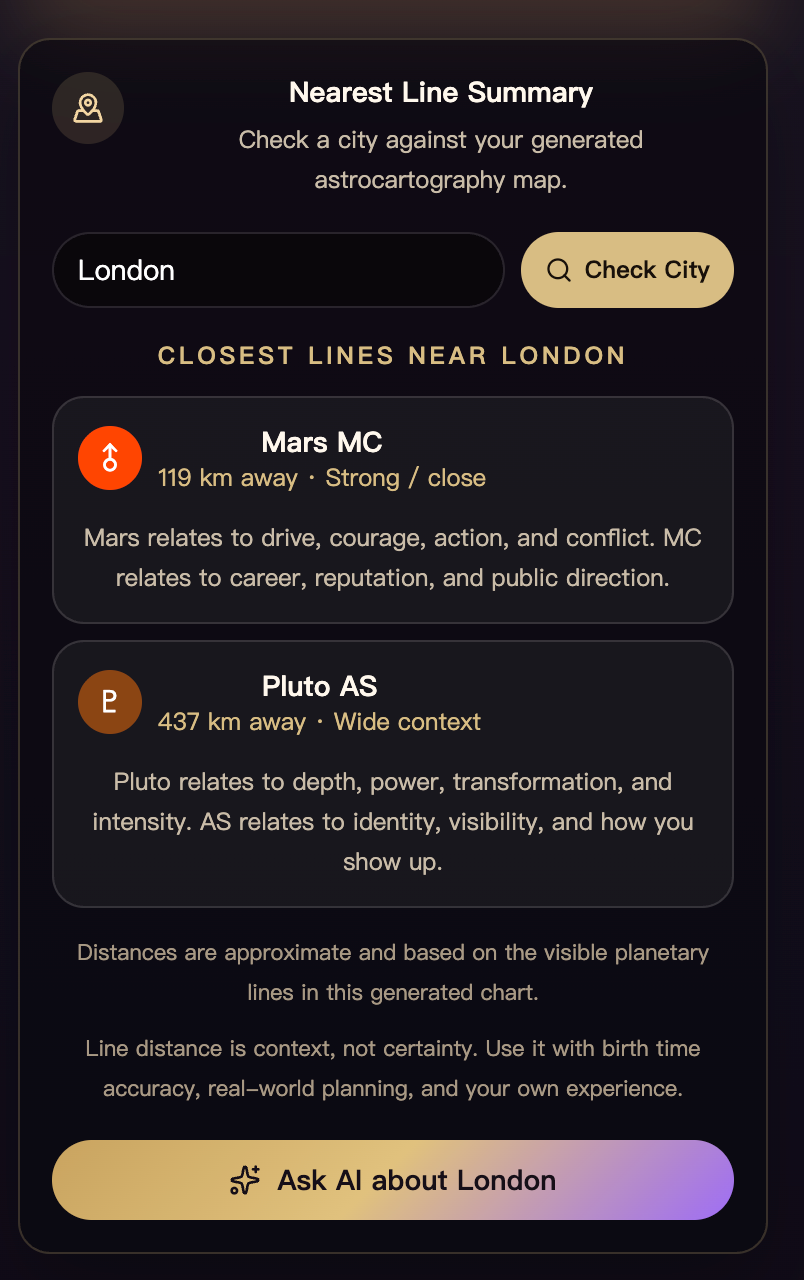
Mars MC · 119 km
Career, public direction, action, and pressure become the first questions to investigate. The line is relevant to a work question because the angle and distance point in the same direction.
Pluto AS · 437 km
Identity, intensity, and transformation remain part of the wider context. It should not be treated as equal to the closer signal or as a verdict about London.
The goal changes the question
Read the same map for the decision you actually face.
There is no universal best line. A map becomes more useful when the question is specific enough to test and broad enough to leave room for practical evidence.
Career or public work
Start with MC signals and ask what kind of visibility, authority, or pressure a city might bring. Then check whether an adjacent line changes the pace or the people involved.
Home or relocation
Give IC and AC signals a closer look, but do not treat a line as a housing recommendation. Compare belonging, independence, practical costs, family needs, and the nearest city evidence.
Love or collaboration
Read DC and Venus themes together with the actual relationship question. A line can describe attraction, negotiation, projection, or boundaries; it cannot guarantee a partner or an outcome.
Travel or a temporary project
A map can frame a shorter stay as an experiment. Define what you want to notice, how long you will be there, and what practical evidence will tell you whether the experience fits.
Keep the limits visible
When the map looks confusing, narrow the question.
A crowded or quiet map is not a failed map. These cases change how cautiously you interpret a signal and what you should verify before making a location decision.
Several lines near one city
Read the combination rather than choosing the most attractive planet. One line may support a goal while another adds deadlines, intensity, or relational work. Keep the trade-off visible.
No close line
A city without a close line is not automatically negative. It may give you a less concentrated signal, or the nearest line may still offer a useful background question at a wider distance.
A line over water
An ocean path is part of the map, but it does not justify a precise claim about a land location. Use nearby coastal places as comparison points and keep the map boundary clear.
Uncertain birth time
The angles move with birth time. If your time is estimated, treat close-distance conclusions as provisional and look for patterns that remain stable across a reasonable time range.
A complete reading example
Venus MC near Lisbon: apply the sequence before deciding.
Imagine that Lisbon sits 85 km from a Venus MC line and your question is whether the city could support a more visible creative career. The map does not answer yes or no. It gives you a useful order for the next questions.
- Planet: Venus makes connection, aesthetics, cooperation, and value worth examining.
- Angle: MC moves those themes toward public work, reputation, and professional direction.
- Distance: 85 km makes the signal relevant to investigate, without turning it into a guarantee.
- Question: compare the creative opportunity with costs, work conditions, relationships, and another realistic city.
A careful conclusion is that Lisbon deserves further research for this goal. That is more useful than declaring Venus MC universally good or treating a single line as a relocation instruction.
Read my own map this wayQuestions people ask first
Keep the method close while you read your own map.
These answers explain the reading method without turning a line, distance, or city into a fixed prediction.
How do I learn how to read an astrocartography map?
Begin with the planet, identify whether the line is AC, DC, MC, or IC, check its approximate distance from a real city, compare nearby signals, and return to the goal you are researching. The sequence keeps a map reading specific without turning it into a guarantee.
What do the lines on an astrocartography map represent?
Each line marks where a planet was rising, setting, overhead, or below the horizon at your birth moment. The planet supplies the theme and the angle shows the area of life where that theme may become noticeable.
Which line should I read first?
Read the line that is closest to a place connected to your real question. There is no universal best line; relevance depends on planet, angle, distance, nearby signals, birth-time confidence, and the decision you are making.
How important is distance on an astrocartography map?
Distance helps you compare how directly a visible line relates to a city. It is context rather than a fixed guarantee. A close line deserves attention, while a wider signal should be read with more room for uncertainty.
Can I use an astrocartography map for travel?
Yes. A trip, retreat, study period, or work project can be a valid location question. Define the purpose and duration first, then read the map as one source of reflection alongside ordinary travel planning.
Does a map tell me exactly where I should move?
No. It can help you form a better location question and compare signals around real places. Housing, work, safety, health, relationships, legal conditions, and lived experience remain part of the decision.
Your map is the starting point
Now read the map that belongs to you.
Generate your personal map, choose one real city and one real question, then work through planet, angle, distance, nearby signals, and practical reality in that order. Once you know how to read an astrocartography map, use the method on a place that matters to you.
Generate my astrocartography map