
A personal map for a real decision
Astrocartography Where to Live
An astrocartography where to live question is not just “which line looks best?” Start with your goal, generate your personal map, and compare the places you could genuinely live. Read planet, angle, distance, support, caution, and practical reality together before deciding what deserves a closer look.
Generate your personal astrocartography map
Start with the decision, not the planet
What an astrocartography where to live result should help you decide.
A general line guide can tell you what Venus, Saturn, or the Moon may symbolize. A useful astrocartography where to live reading goes one step further: it connects your birth data to a real map, then connects that map to a goal and a place. The result should make the next question clearer, not make a city sound destined.
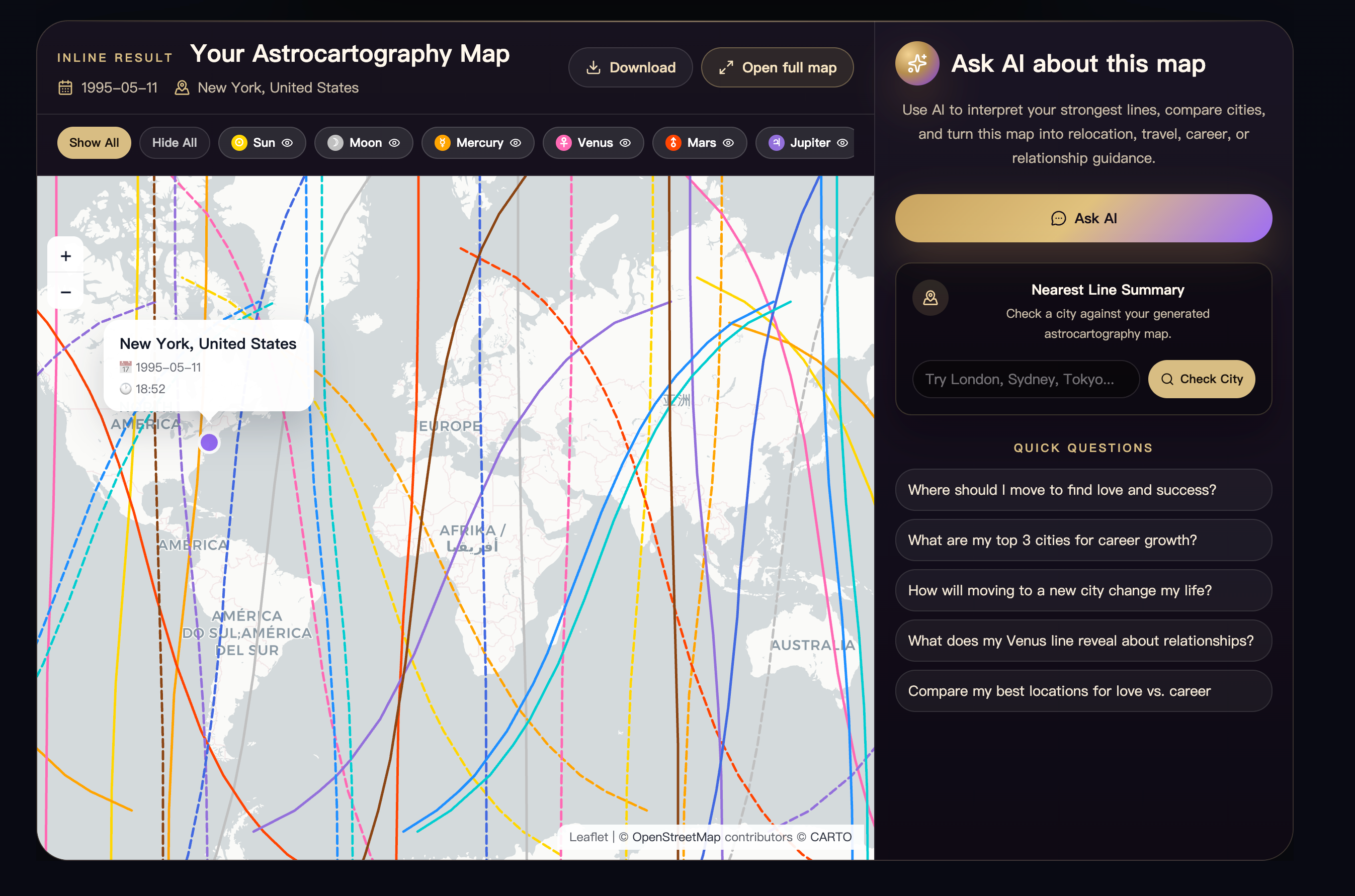
Five pieces belong in the same reading
The planet describes the subject, the angle describes how it enters life, and distance tells you which visible signal to examine first. Your goal decides what counts as relevant, while ordinary research tests whether the place can support your life.
This is the information gain behind an astrocartography where to live page. It helps you compare two plausible places without flattening every line into “good” or “bad.”
Learn how to read your map firstThree ways into the question
Choose the starting point that matches what you know.
Not every astrocartography where to live search starts with the same amount of information. Begin with a goal and a region when you need a direction, a city check when you already have a place, or a comparison when several options are realistic.
A city you already have in mind
Check the nearest visible signals around that city. Record the planet, angle, approximate distance, and proximity strength together, then ask what the result adds to your existing practical research.
A shortlist of two to four cities
Compare the same goal across realistic options. Look for the leading support signal, the main caution, the distance difference, and the reason one city deserves more research rather than declaring a winner too early.
No city has been chosen yet
Start with a goal and a region, then treat the candidate list as a research queue. A shortlist is useful when it gives you places to investigate, not when it claims to know your future before you check the facts.
A current city that needs context
Use your current city as a reference point. Comparing what is familiar with what is new can reveal whether a candidate offers a different emphasis, a meaningful trade-off, or simply a louder interpretation of the same question.
A repeatable location method
Five passes for an astrocartography where to live decision.
When a map contains too many lines, use this order. It keeps a striking signal from taking over the whole reading and turns a broad question into a short list of evidence you can verify.
Name the life you want to support
Start with a decision you can describe in ordinary language: a stable home, a more visible career, a relationship reset, or a balanced move. A goal gives the map a useful question instead of asking it to name one universally best city.
Generate the map behind the question
Your birth date, time, birthplace, coordinates, and timezone place the planets on the world map. If your birth time is estimated, keep angle-based conclusions and close city differences provisional.
Choose the right starting place
You can begin with no city, one city, or a short list of realistic options. The useful path depends on what you know already; it is not necessary to pretend that every location decision starts from a blank world map.
Read support and pressure together
Planet, angle, distance, nearby lines, and confidence belong in one reading. A supportive signal may come with responsibility, intensity, or a different life-area trade-off that matters to the same move.
Take the next practical step
Use the map to decide what to research next: housing, work, safety, visa rules, health, family, timing, or a short visit. A useful astrocartography where to live result narrows the question; it does not replace your decision.
What would change your mind?
Before treating a place as a serious candidate, name the fact that could disqualify it: housing cost, work access, safety, health, family needs, visa rules, or how the place feels when you spend real time there.
The goal changes the meaning
Read a city for the life you are actually trying to build.
An astrocartography where to live result should not treat every move as the same move. The same city can be relevant for public work, private roots, relationships, or a short experiment for entirely different reasons.
Belonging and a stable base
For a home question, notice IC and AC themes, family patterns, privacy, and the kind of daily rhythm a place might invite. A line that looks exciting for public life may be less relevant when your priority is rest, roots, or emotional room.
Visibility, work, and direction
For career, look closely at MC signals and ask what kind of visibility or responsibility a city might bring. A strong public signal is a reason to examine opportunities and pressure, not a promise of success or a substitute for the local job market.
Connection with boundaries
For love or collaboration, DC and Venus themes can help you ask about attraction, cooperation, projection, and boundaries. The map can frame a relationship question, but it cannot guarantee a partner or make another person’s choices predictable.
A place you can actually sustain
For balanced living, compare the full mix: support, caution, distance, cost, pace, climate, community, and your current city. The best candidate may be the clearest trade-off rather than the city with the most dramatic line.
A city example, kept honest
Lisbon can be a candidate without becoming a prediction.
Imagine that Lisbon sits 85 km from a Venus MC line and your goal is a more visible creative career. Venus may make connection, aesthetics, and cooperation worth examining; MC moves those themes toward public work. That combination tells you what to investigate around Lisbon. It does not prove that moving there will produce a particular outcome.
Compare the signal with another realistic city, local work conditions, housing, relationships, and the experience of a short stay. The value of the astrocartography where to live method is the quality of the next question, not the certainty of the headline.
More visible creative work
Venus MC · 85 km · relevant signal
Which opportunities, costs, collaborators, and pressures are actually present?
Lisbon deserves further research for this goal; it is not a guaranteed answer.
Keep the boundary visible
Where to live with astrocartography means comparing evidence, not chasing certainty.
A map can organize a meaningful question while still leaving room for uncertainty. These cases change how much weight an astrocartography where to live result should carry.
The closest line is not automatically the best line
Distance tells you which signal deserves attention first. It does not rank every life goal, erase practical constraints, or turn a difficult theme into a bad city. Let the question decide what the evidence means.
Several lines sit near one city
Read the combination as support and pressure in the same place. One line may describe opportunity while another asks for boundaries, pace, or a deeper change. Keep the trade-off visible instead of choosing one colour.
No close line appears
A quiet map result is not a rejection. Wider signals can remain background context, and a city can still be right for practical or personal reasons that the map does not measure. Treat the result as lower concentration, not a verdict.
Your birth time is uncertain
Angle lines move with birth time. If the time is estimated, be cautious with close rankings and small distance differences. Prefer patterns that remain stable across a reasonable time range and verify the time when possible.
Use the result as a research queue
Turn “Where should I live?” into a smaller set of checks.
Once your personal map gives you a few candidates, keep the interpretation practical. A serious shortlist should tell you why a city entered the conversation, what supports your goal, what deserves caution, and which ordinary facts you need to verify next.
- Candidate: name the city and the life goal you are testing.
- Signal: record the planet, angle, distance, and proximity strength together.
- Trade-off: write one support and one caution before calling the result promising.
- Reality: check work, housing, safety, health, relationships, timing, and your own experience.
This is how an astrocartography where to live result becomes useful without becoming a relocation instruction. You leave with a better research plan and a clearer reason for comparing one place with another.
Review line meanings and anglesQuestions people ask first
Keep the method close while you compare places.
These answers explain the location decision without turning a planet, city, or distance into a fixed promise.
How does astrocartography help me decide where to live?
It gives you a personal map and a way to compare planet, angle, distance, nearby signals, and a real life goal. An astrocartography where to live result is a research starting point, not a guarantee or a replacement for practical due diligence.
What is the best place to live according to astrocartography?
There is no universal best place. The useful candidate depends on what you want to support, which lines are nearby, how confident the birth time is, and whether the practical conditions fit your life. A good result explains trade-offs instead of naming one city without context.
Should I choose the city closest to a Venus or Jupiter line?
A close Venus or Jupiter signal may deserve attention, but it is not a complete answer. Check the angle, nearby lines, your goal, and the city’s real conditions. Supportive symbolism can still come with excess, idealization, or a mismatch with what you need.
Can astrocartography compare two cities for living?
Yes. Compare two to four realistic cities against one goal, then read support, caution, distance, strength, and confidence together. The comparison is most useful when it helps you decide which places deserve further housing, work, safety, and visit research.
What if I do not know which city to choose?
Begin with a goal and a region, then use the resulting candidates as a shortlist for research. Find My Best Places can help organize that first pass, while the final decision still belongs to you and the facts you verify about each place.
Can I use an astrocartography where to live map for a temporary move or trip?
Yes. A temporary stay can be a useful way to test a place before a longer move. Define the purpose and length of the stay, read the relevant signals, and keep ordinary travel, work, health, and safety planning in the same decision.
How accurate is the result without an exact birth time?
You can still explore the map, but angle-based lines and close city comparisons are less precise when the time is estimated. Treat small differences cautiously and focus on conclusions that remain consistent across a reasonable time range.
Does an astrocartography where to live result tell me to move?
No. It can help you form a clearer question, compare candidate places, and identify evidence worth checking. It should not override finances, legal conditions, employment, health, family needs, safety, or what you experience in the place yourself.
Your place question starts with your map
Find places worth researching for the life you want.
Generate your personal map, choose one real goal, and begin with a city you know or a region you are curious about. Use the result to compare support, caution, distance, and practical reality before you decide what to do next.
Start my astrocartography where to live reading