Astrocartography Without Birth Time: What Your Map Assumes
Astrocartography without birth time can produce an estimated map. The unknown-time option below uses 12:00 local time at your birthplace. Its city readings describe that assumption; they do not recover your birth time or establish your actual angular lines.
I left the time unknown. Why is there still a city reading?
Perhaps you know your birthday and the town where you were born, but the family copy of your birth record has no time. You can still enter those details and select “I don’t know my birth time.” A map appears, and a city you recognize has named lines and a readable interpretation. That completeness can make the missing input easy to forget.
For astrocartography without birth time, the distinction is between a calculation that can run and an input that has been established. The form supplies noon so a calculation is possible. It also keeps an estimated-time flag. The warning on the result is part of understanding that result, even when the city text reads fluently.
Birth time was not provided, so this map uses 12:00 local time as a fallback. Treat angle lines and close city comparisons as less precise.
Current unknown-time map notice
In Astrocartography Chart, the free In-Depth Location Readings connect a city to calculated planet-and-angle labels, distances and an interpretation. Here they let us ask a concrete question: if the birth time is only a placeholder, which part of the answer about this particular city depends on it?
The answer becomes clearer when the city stays fixed. We do not need to compare an attractive holiday destination with somewhere unfamiliar. Below, Valencia stays in exactly the same position while three clock assumptions produce different reading evidence. You can see what the words refer to before deciding how much of an estimated reading to carry into your own question.
One Valencia. Three different starting assumptions.
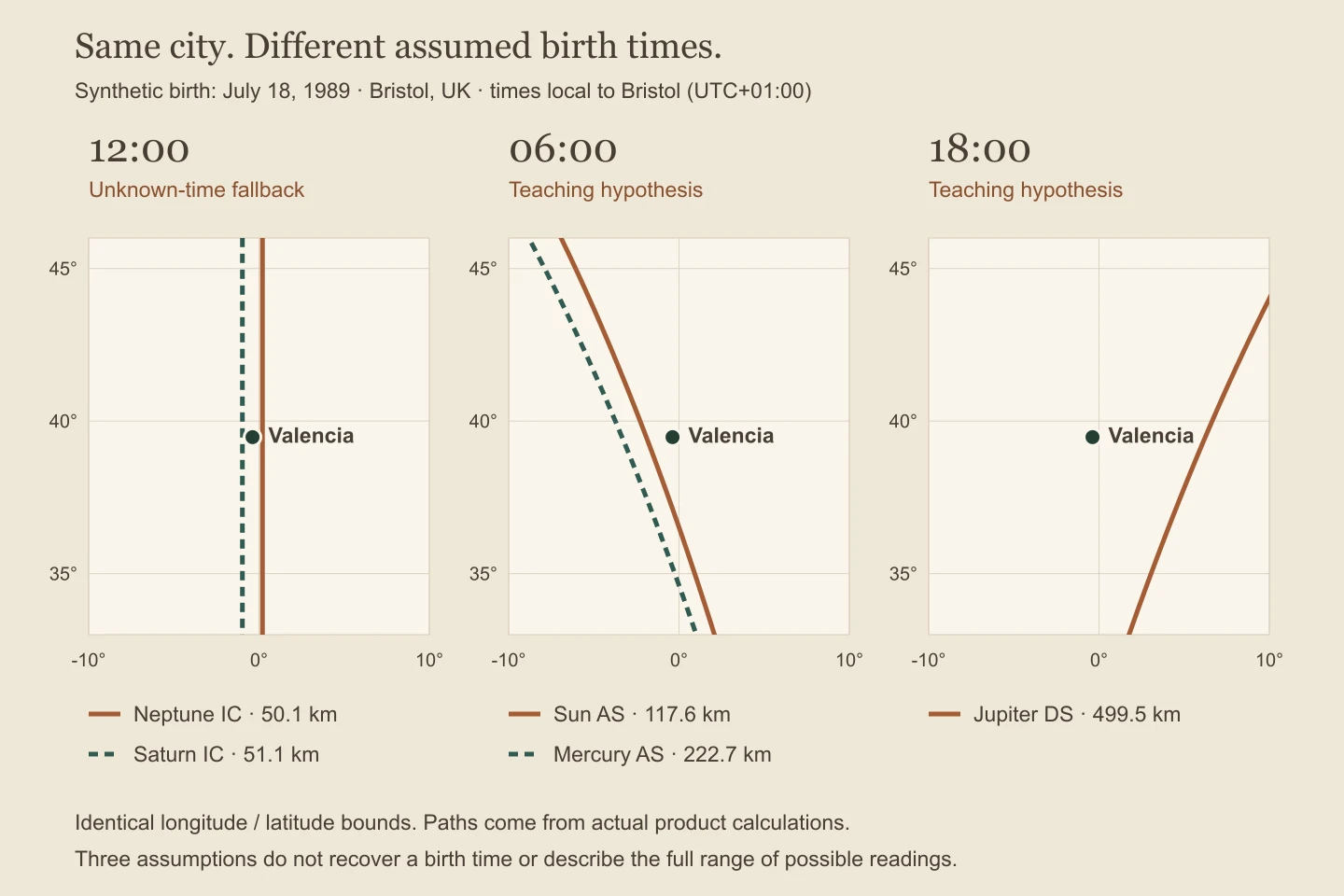
This is a synthetic birth: July 18, 1989, in Bristol, United Kingdom. Bristol is the birthplace; Valencia, Spain, is the city being read. The date, birthplace and destination stay fixed. All ten standard planets are visible, with no single line selected. The saved location previews use the same calculation and reading functions as the product.
Only 12:00 represents the current unknown-time form choice. The 06:00 and 18:00 calculations are teaching hypotheses, not extra modes offered by the form. All three retain an estimated-time status. They are neither recovered times nor the endpoints of a known birth-time range. For this date, Bristol’s local time is UTC+01:00; “12:00” does not mean noon in Valencia.
| Assumed Bristol time | Returned line evidence | What this time represents |
|---|---|---|
| 12:00 | Neptune IC · 50.1 km · Strong Saturn IC · 51.1 km · Strong | Unknown-time noon fallback |
| 06:00 | Sun AS · 117.6 km · Strong Mercury AS · 222.7 km · Nearby | Editorial teaching hypothesis |
| 18:00 | Jupiter DS · 499.5 km · Wide | Editorial teaching hypothesis |
In astrocartography without birth time, even the nearest planet name is conditional on the assumed clock. Noon puts Neptune IC first here. The morning hypothesis puts Sun AS first; the evening hypothesis returns Jupiter DS. Valencia has not changed, and we have not learned that any one of those times is correct.
The distance labels do not settle the missing-time question. Neptune’s 50.1 km is a distance to the noon calculation’s line. Jupiter’s 499.5 km is a distance under the evening hypothesis. Neither number measures the likelihood of that birth time. A Strong label describes proximity in that result, not confidence that the assumed time matches a real birth record.
The city text changes with the evidence behind it
A person considering Valencia as a home base might pause at the noon result. Both returned angles are IC, whose description concerns home and inner life. That could feel especially relevant to the question they brought. Reading the other assumptions prevents that relevance from silently becoming confirmation of the missing time.
Neptune is the strongest visible theme here, with Saturn adding a secondary influence. Read them together rather than as a guaranteed outcome.
Neptune relates to dreams, intuition, creativity, and ambiguity. IC relates to home, roots, inner life, and emotional foundations.
Saturn relates to structure, responsibility, pressure, and mastery. IC relates to home, roots, inner life, and emotional foundations.
Sun is the strongest visible theme here, with Mercury adding a secondary influence. Read them together rather than as a guaranteed outcome.
Sun relates to visibility, confidence, recognition, and leadership. ASC relates to identity, visibility, and how you show up.
Mercury relates to communication, learning, writing, and trade. ASC relates to identity, visibility, and how you show up.
Jupiter is the clearest visible theme near this point. Treat it as decision-support context, not certainty.
Jupiter relates to growth, opportunity, expansion, and wisdom. DSC relates to relationships, attraction, and one-to-one connection.
The three interpretation sentences and the planet-and-angle descriptions above reproduce the saved product wording. The discussion below is editorial explanation. None of these is a customer story, a relocation verdict or evidence of an event.
At noon, Neptune’s dream, intuition and ambiguity themes sit beside Saturn’s structure and responsibility themes. IC gives both a private-life setting. The useful reading question is how those themes sit together, rather than treating the first planet as an unqualified promise of a peaceful home. But the more basic question remains whether noon describes the birth at all.
At 06:00, the actual text gives Sun the lead and Mercury a secondary influence. Its angle descriptions now concern identity and how someone shows up. That shifts the conversation from private foundations toward expression, visibility and communication. It is a different basis for discussing the same place, not additional evidence supporting the noon home reading.
At 18:00, only one line is returned within this preview’s range. The interpretation names Jupiter, and DSC supplies a relationship-oriented context. The Wide label remains visible. This is not a higher-rated Valencia or a more accurate clock: the one-line reading simply has different supporting material. The earlier Neptune and Saturn interpretation cannot be carried over unchanged.
This is the practical gain from looking at actual city readings for astrocartography without birth time. You can trace a fluent answer to a specific assumption and see a different assumption change the answer’s subject. The examples demonstrate dependence; they do not calculate every possible version of Valencia or establish a stable theme across an unknown day.
What can I understand about my city today?
Suppose Valencia interests you because of a language course, while your partner is thinking about a longer stay. Those are different questions to bring to a city reading. The examples above give private foundations, personal expression and one-to-one connection distinct supporting evidence. Keeping your question specific helps you recognize which subject a displayed interpretation addresses.
For astrocartography without birth time, you can still connect the words in your reading to the labels actually returned. In the noon example, both IC lines supply a home context. The morning expression themes and evening relationship themes belong to separate assumptions. Combining all three would lose the link between each interpretation and its input.
A useful observation would be: “Under the noon estimate, Valencia’s reading connects Neptune and Saturn with home and inner life.” That gives you something specific to discuss: how the two themes fit together within the same private-life question. Keep the noon assumption beside that observation so you can revisit it when better birth information becomes available.
What should I recheck when I find a recorded time?
With astrocartography without birth time, begin with the date and birthplace you know and select the existing unknown-time option in the form above. In the generated map, read a city you care about. Keep your original question alongside its estimated-time notice and the planet-and-angle evidence you want to understand.
Once you obtain a reliable birth time, generate a fresh map with the same birth date and birthplace, then revisit that city. Is the leading planet still the same? Has its angle changed? What distance and strength label accompany it? Read the new interpretation against those fields before returning to your original question.
The Valencia examples make that review concrete. A shift from Neptune IC to Sun ASC would change both the main theme and its setting; a change in distance alone would leave a different question about proximity. Your documented-time result may retain an earlier label or return something different. Explain the city using the evidence it actually returns.
The map and full location readings are free. Complete personal reports and timing analysis require an accurate birth time, as current Pricing explains. Confirm that information before buying specifically for those answers; a purchase cannot improve a missing time.
Explore your estimated mapAstrocartography without birth time: questions to keep clear
Can I use astrocartography without birth time?
You can generate an estimated map and explore how location readings work. Select the unknown-time option instead of presenting a guessed clock value as recorded information. The current form uses 12:00 local time at the birthplace and marks the result as estimated. A generated city description does not establish that the displayed angular lines match your actual birth moment.
Does 12:00 mean noon where I want to live?
No. It is local noon at your birthplace on your birth date. In the synthetic example, Bristol supplies the birth location and time zone; Valencia is the place being read. Changing the destination is a separate question from changing the birth details. Noon is a calculation fallback, not evidence that you were born around midday.
Is an approximate time enough for a personal city conclusion?
An approximate time can support a clearly labelled hypothesis, but this page provides no universal safe margin. A family memory such as ‘early morning’ does not establish an exact minute. Keep the source and uncertainty visible. The three examples here are deliberately different assumptions, not a test that validates an approximate time or bounds every possible result.
Can astrocartography without birth time reveal my missing time?
These map and location-reading functions do not recover or rectify a birth time. A description that resembles your life can suggest a question to explore, but choosing the most appealing reading does not verify the clock value behind it. Look for a time-bearing birth record or other reliable documentation; do not turn a preferred interpretation into a recorded input.
Would buying a report make an unknown birth time more accurate?
No. Current Pricing directs people with unknown times to start with the free estimated map. Purchasing access does not improve the underlying birth time. Complete personal reports and timing analysis require an accurate birth time. Confirm that information before purchasing specifically for those answers; a longer interpretation cannot supply a missing observation.
What should I revisit after finding a reliable time?
Generate a new map with the documented time, the original birth date and the correct birthplace. Revisit the same city and your original question. Check the returned planet-and-angle labels, distances and interpretation again. A previous estimated reading remains an example of its earlier assumption; do not carry its city conclusion into the new result without checking it.