
Planet × angle meanings
Astrocartography Lines & Their Meanings
Astrocartography lines show where each planet met an angle at your birth moment. Generate your map, then connect the planet, angle, distance, and real place question before you interpret a location.
Generate your personal astrocartography map
Map evidence first
What a map result actually tells you.
This sample result shows how a personal map moves beyond a generic explanation. Read the exact planet, angle, distance, and strength together, then return to the question you are asking about the place. None of those layers turns a location into a guaranteed outcome.
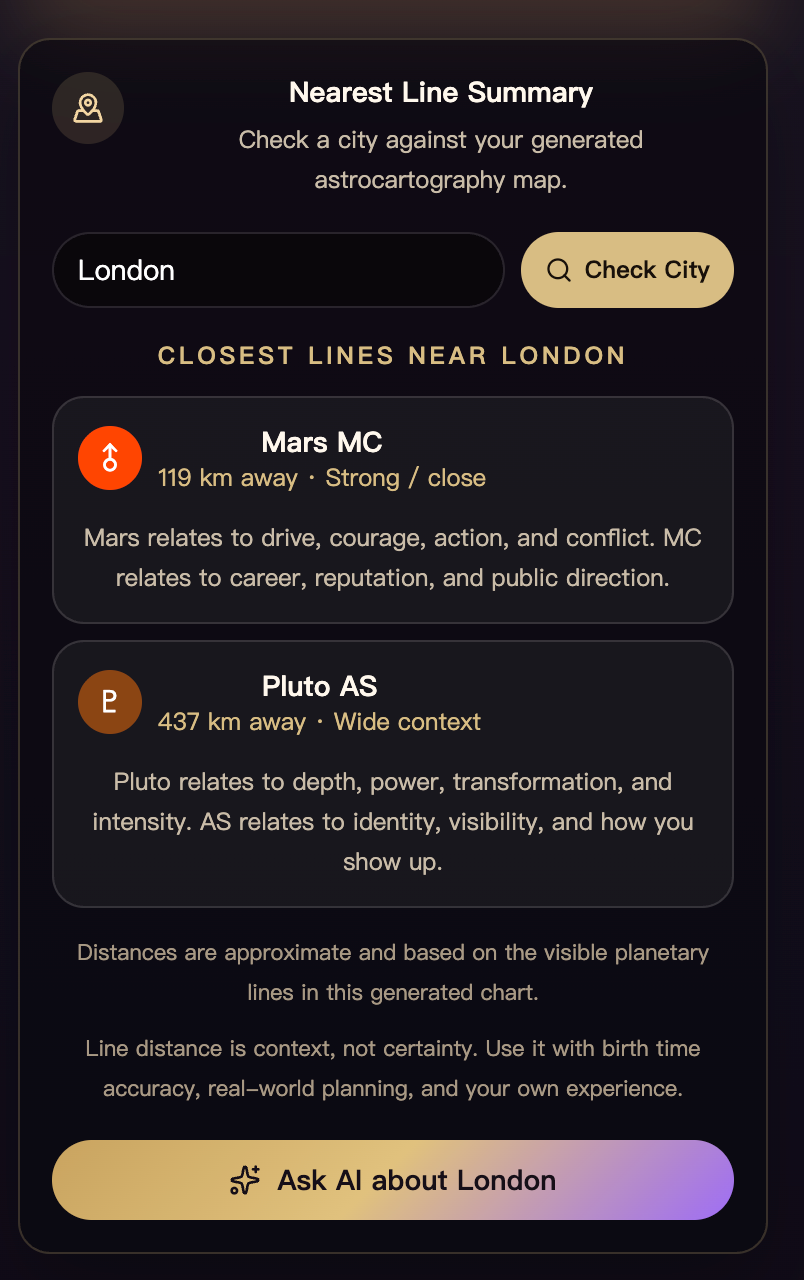
Mars MC · 119 km · strong / close
Mars brings drive, action, and friction into the MC themes of career, reputation, and public direction. This map result gives a concrete signal to investigate around London; it does not call the city good or bad.
Pluto AS · 437 km · wide context
Pluto adds depth, power, and transformation to the Ascendant themes of identity and visibility. At this distance these astrocartography lines provide context around the closer Mars MC signal, not an equal-strength verdict.
Keep the evidence together
Planet, angle, distance, and proximity strength belong to the same reading. Removing any one of them turns a map result into a generic line definition.
Ask the place-level question
For a career question, ask what the Mars MC signal might emphasize and whether Pluto AS adds intensity or reinvention. For a home question, the same result asks a different question.
Leave room for reality
The distances are approximate and based on visible lines. Birth-time accuracy, work, housing, safety, health, and lived experience still belong alongside astrocartography lines in a map-based decision.
A useful reading frame
What astrocartography lines mean on your personal map.
A map line is not a label that tells you whether a city is good or bad. It is a location-specific prompt. Read the planet, angle, distance, and question together so the map adds evidence to a decision you already need to make.
Planet is the subject of astrocartography lines
Astrocartography lines begin with a planet. The Sun can bring questions of identity and visibility; Venus can bring connection, taste, and cooperation; Saturn can bring structure, duty, and limits. These are themes to investigate, not promises about what must happen.
Angle is the life area of astrocartography lines
The angle tells you where these astrocartography lines tend to be noticed. AC points toward identity and beginnings, DC toward encounters and partnership, MC toward public direction, and IC toward home and inner foundations. The same planet can feel different across astrocartography lines on each angle.
Distance is the context for astrocartography lines
A city check gives the approximate distance from visible astrocartography lines. Closer usually makes the signal more relevant to examine, while a wider distance may be useful as background context. Distance does not turn symbolism into a guaranteed event.
The question gives a map signal its purpose
Astrocartography lines become useful when read against a real question: career, relationships, home, travel, study, or a temporary project. Without a question, the interpretation stays broad. With one, you can compare the same place with the part of life you actually need to understand.
The four angles change the story
Read astrocartography lines through their angles.
Planet meaning alone is too broad. The angle tells you where the astrocartography lines enter daily experience, so it is the first distinction to make when two places share the same planet.
AC astrocartography line · how you enter a place
AC astrocartography lines put the planet close to your presentation, body, and first moves. Notice how you introduce yourself, what kind of initiative feels natural, and whether the place invites a new version of you. It can feel personal before it becomes public.
DC astrocartography line · who meets you there
DC astrocartography lines bring the planet into partnership, clients, and significant encounters. Ask what other people mirror or ask of you. A Venus DC line may invite ease, while a Mars DC line may sharpen attraction and disagreement at the same time.
MC astrocartography line · what becomes visible
MC astrocartography lines make career, reputation, and public direction easier to question. They can describe leadership, recognition, pressure, or a change in professional identity. Visibility still requires skill, timing, and conditions outside the map.
IC astrocartography line · what becomes private
IC astrocartography lines turn attention toward home, family, roots, and the private story underneath a decision. They may support belonging or bring old patterns into view. A quieter location can still be a significant one when the goal is foundation.
From map to place
How to read astrocartography lines around a city.
A map becomes useful when it can stay attached to a place you might actually visit, work in, or call home. Use this sequence to move from visual astrocartography lines to a grounded question without asking the chart to make the decision for you.
Name the decision
Write the question in ordinary language before interpreting astrocartography lines. “Could this city support a more visible creative career?” gives you a better starting point than “Is this my best city?”
Read the nearest signal
Note the planet, angle, approximate distance, and proximity strength together for these astrocartography lines. A Mars MC at 119 km asks a different question from a Pluto AS at 437 km, even when both appear in the same city result.
Look around the line
Astrocartography lines rarely explain a whole location alone. Check whether another line supports, complicates, or redirects the first theme. The combination can reveal a trade-off that a single planet definition hides.
Separate meaning from facts
Use the map for a symbolic question, then research housing, work, safety, health, visas, relationships, and timing. Astrocartography lines can shape what you investigate; they cannot replace the investigation.
Compare before deciding
If another city is realistic, read the same astrocartography lines there. Comparing like with like helps you see differences in distance, angle, nearby signals, and practical fit instead of chasing a favourite planet.
Ten planets × four angles
Astrocartography lines and their meanings at a glance.
Use this reference to orient yourself before opening a deeper line guide. The full interpretation still depends on distance, nearby lines, chart context, and the place you are evaluating.
| Planet | AC · Identity | DC · Relationships | MC · Public life | IC · Home |
|---|---|---|---|---|
| Sun | Self-definition and visible beginnings | Recognition through important others | Leadership, visibility, and public direction | Belonging, roots, and private confidence |
| Moon | Emotional expression and personal safety | Care, attachment, and emotional dependence | Public response, care, and changing visibility | Family, memory, privacy, and belonging |
| Mercury | Curiosity, movement, and a learning identity | Conversation, clients, and mental exchange | Writing, teaching, media, and commerce | Study, visitors, and activity around home |
| Venus | Charm, style, and attraction | Partnership, cooperation, and social ease | Diplomacy, creative work, and public appeal | Comfort, beauty, and domestic harmony |
| Mars | Drive, directness, and physical energy | Attraction, assertion, and possible friction | Competition, initiative, and action under pressure | Activity, independence, and heat at home |
| Jupiter | Confidence, exploration, and wider possibility | Mentors, generous partners, and expanding expectations | Growth, teaching, recognition, and overreach | A larger home base, hospitality, and restlessness |
| Saturn | Discipline, boundaries, and self-command | Commitment, responsibility, and emotional distance | Authority, duty, and durable achievement | Family responsibility, property, and private burdens |
| Uranus | Reinvention, independence, and sudden change | Unconventional bonds and a need for space | Innovation, technology, and an unpredictable path | Unusual living arrangements and a private reset |
| Neptune | Sensitivity, imagination, and blurred identity | Idealization, compassion, and unclear boundaries | Creative or spiritual work with less certainty | Retreat, sanctuary, and blurred domestic expectations |
| Pluto | Transformation, intensity, and self-examination | Intimacy, power, trust, and necessary honesty | Influence, strategic change, and institutional pressure | Ancestral patterns, privacy, and deep inner change |
Start with your own map so the astrocartography lines stay connected to a real place and a real question.
Learn how to read the mapKeep uncertainty visible
When one map signal is not enough.
The map is strongest when it shows what to examine next. These common situations do not cancel the meaning of astrocartography lines; they tell you how much weight to give it and which question to ask before drawing a conclusion.
Several astrocartography lines near one city
Treat overlapping line meanings as a conversation between themes. A supportive line may open an opportunity while a demanding line asks for structure or boundaries. Keep both in the question.
No close line
A city without close astrocartography lines is not automatically negative or unimportant. It may offer more room to observe ordinary life, or its nearest signals may sit at a wider distance and need a lighter interpretation.
A line over water
An ocean path is still part of the map, but it should not be turned into a precise land-based claim. Use nearby coastal places as a prompt for comparison and keep the distance and map limits visible.
An uncertain birth time
The angle of astrocartography lines depends on birth time. If the time is estimated, keep close city readings provisional and focus on patterns that remain stable across a reasonable time range.
From line to location
Use astrocartography lines to investigate a place you care about.
Astrocartography lines become useful when they help answer a specific question: where to live, where to travel, what kind of work environment to test, or which relationship themes deserve a closer look.
How astrocartography lines help with a city you already have in mind
Begin with the city rather than a favourite planet. The nearest astrocartography lines give you a starting signal, but their meaning changes with the angle, your goal, and the other lines around the same place. Close Venus astrocartography lines can describe connection or comfort; they cannot decide whether the city works for your health, work, budget, or relationships.
When you are looking for a direction from a map line
There is no universally best set of astrocartography lines. A Sun MC may be relevant when public visibility matters, while a Moon IC may matter more when the question is belonging. The useful comparison is between a place and your question, not between planets ranked as good or bad.
When several astrocartography lines speak at once
A city can sit near supportive and demanding signals at the same time. Read the combination as a trade-off: one group of astrocartography lines may open a door while another asks for commitment, boundaries, or a slower pace. That layered reading is more useful than choosing the strongest colour on the map.
A repeatable reading method
From a map signal to a question you can investigate.
Start with the place and goal you actually care about. The map supplies a prompt for research; it does not invent a result.
What do I need this place to support?
Planet + angle + distance + proximity strength
The life area and theme suggested by that combination
Nearby signals, practical conditions, timing, and lived experience
Use the signal to choose the next question to investigate, then compare the place with another realistic option and keep practical evidence in the decision.
Read this pattern on my mapCommon questions
Start with astrocartography lines, then add context.
These answers keep astrocartography lines meaningful without turning them into promises about a city or a future event.
What are astrocartography lines?
Astrocartography lines mark where planets were rising, setting, overhead, or below the horizon at your birth moment. The planets supply themes and the angles identify the life areas.
What is the difference between a line's AC, DC, MC, and IC?
AC relates to identity and beginnings, DC to relationships and other people, MC to career and public direction, and IC to home and private foundations.
Does living near a map line guarantee a result?
No. Astrocartography lines are one layer of location evidence. Distance, nearby lines, chart context, practical constraints, and the question you are asking all affect how useful the signal is.
How should I use a line's planet and angle meanings?
Start with a real goal, identify the planet and angle, check the distance to a city, and then compare that signal with the rest of the map and the practical facts about the place.
Which astrocartography lines are best?
There is no universally best set of lines. The useful signal depends on the life area you are asking about, the planet theme, distance, nearby lines, and the practical reality of the place.
What if several astrocartography lines are close to one city?
Read each of the astrocartography lines as part of a combination of support and pressure. One signal may describe opportunity while another adds responsibility, friction, or a different life area that needs attention.
What are the four main angles of astrocartography lines?
AC describes identity and beginnings, DC describes relationships and significant others, MC describes career and public direction, and IC describes home, roots, and private foundations.
How do I find my astrocartography lines?
Enter your birth date, birth time, and birthplace to generate a personal map. Then identify the planet, angle, approximate distance, and city question attached to the astrocartography lines you want to understand.
How close should a city be to astrocartography lines?
There is no universal cutoff that guarantees an experience. Use the approximate distance as context, give closer astrocartography lines more attention, and compare the result with nearby lines, birth-time accuracy, and practical facts about the city.
Your map is the starting point
Find the astrocartography lines that matter to your question.
Generate your map, identify the planet and angle, and use this astrocartography lines to choose the next place to investigate.
Generate my astrocartography map