Astrocartography Crossing Lines: Read the Intersection
Astrocartography crossing lines meet at a particular geographic point. A city can be close to both paths while farther from their intersection. Your location reading connects the actual pair and crossing distance to the place you want to understand.
Two close lines. Why only one nearby crossing result?
You have circled a busy area of your map and noticed two paths meeting. The useful question about astrocartography crossing lines is where that meeting point sits relative to your chosen city. Zooming out can make several places look equally close; their location readings can preserve an important difference.
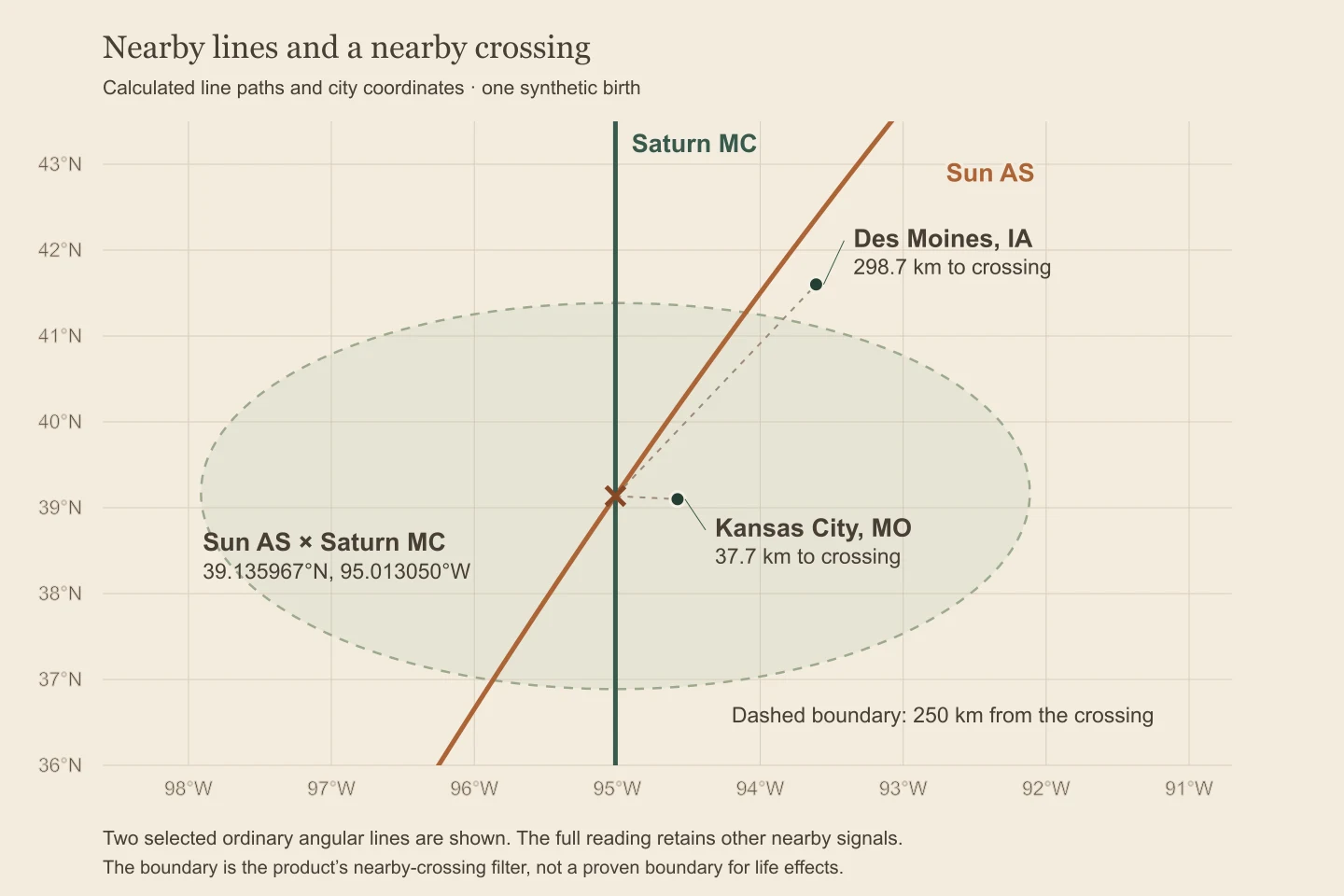
In this calculated example, Kansas City and Des Moines are both close to Sun AS and Saturn MC. Only Kansas City returns the Sun AS × Saturn MC pair as a nearby crossing. Astrocartography crossing lines have a location of their own, even when the two individual paths continue through the surrounding region.
In Astrocartography Chart, In-Depth Location Readings show that distinction through the Nearby line crossing evidence and the interpretation beside it. These actual results ground a question about astrocartography crossing lines in a specific place, rather than leaving you with a general description of two planets.
Synthetic birth: February 12, 1986, 14:20, Copenhagen, Denmark (Europe/Copenhagen). Kansas City means Kansas City, Missouri. This is an illustrative calculation, not a customer’s experience or a recommendation to move to either city. AS, AC and ASC name the Ascendant; the saved reading below uses ASC. The full readings use all ten standard planets visible, with no single line selected.
| Selected city | Sun AS line | Saturn MC line | Reference crossing | Nearby crossing returned |
|---|---|---|---|---|
| Kansas City | 36.9 | 37.5 | 37.7 | Sun AS × Saturn MC |
| Des Moines | 27.4 | 116.7 | 298.7 | None in this result |
Kansas City is 37.7 km from the intersection. Des Moines is 298.7 km from that same point. The latter number is an editorial distance check using the product’s geometry, so you can compare the same crossing. It is not a crossing card returned for Des Moines.
Notice the apparent puzzle: Des Moines is closer to the Sun AS path than Kansas City is. That has not moved it closer to the intersection. With astrocartography crossing lines, distance to a path and distance to a meeting point answer different questions. Keeping both measurements visible resolves the puzzle without treating either result as an error.
What changes in the actual location reading?
The same planet names appear in both readings. The difference is whether the location has a returned nearby intersection as well as the individual lines. For astrocartography crossing lines, this is more useful evidence than counting how many colours pass through a region on a small map.
Sun and Saturn lead the visible pattern for this location. The nearby Sun ASC × Saturn MC crossing adds an overlapping theme, so the signals should be read together rather than as separate promises.
Sun is the strongest visible theme here, with Saturn adding a secondary influence. Read them together rather than as a guaranteed outcome.
Kansas City’s interpretation explicitly names Sun ASC × Saturn MC. Des Moines keeps Sun and Saturn together as local themes without naming that pair as a nearby crossing. An empty astrocartography crossing lines result has not erased the two individual paths. Both entries still carry the product’s Strong / close proximity label in the saved data.
The full location reading also retains Jupiter AS and Mars MC in its visible line context. The figure isolates two paths because their intersection is the question being examined. Astrocartography crossing lines add one piece of context; they are not a substitute for the rest of a place reading.
These are saved interpretations from the location readings for the stated synthetic birth. They describe astrological themes, not measured probabilities of an event. Neither excerpt reports a successful relocation, and their different wording does not establish which city will suit your circumstances better.
What could Sun AS × Saturn MC ask you to consider?
Read both complete labels in astrocartography crossing lines. Here Sun is on the Ascendant side of the interpretation: identity, visibility and how you show up. Saturn is on the Midheaven side: public direction, structure and responsibility. Calling the pair simply “Sun and Saturn” leaves those different settings unclear.
As an editorial application, imagine an introductory visit where you want to present your own work and also understand the responsibilities people expect you to take on. The two questions can coexist: how do I make my contribution visible, and what obligations would accompany that public role? This is a way to discuss the calculated themes, not an event predicted for Kansas City or a story supplied by a customer.
A nearby pair does not automatically double a benefit. Personal visibility and public responsibility can involve different demands. A useful astrocartography crossing lines reading keeps that distinction open, alongside what you actually know about the role, people and place. The interpretation helps frame a question; the ordinary facts of the opportunity still need their own answers.
Bring a question you could recognise in your own life rather than asking the intersection to rate an entire city. If your question concerns a relationship or private home life, first look at which angles the pair actually contains. Astrocartography crossing lines should not turn every combination into the same promise of love, career success or belonging.
What can you still read in Des Moines?
Des Moines still has Sun AS at 27.4 km and Saturn MC at 116.7 km. Their local themes remain part of the interpretation even though the intersection is farther away. With astrocartography crossing lines, keep what you can read at the city separate from where the two paths meet on the map.
The intersection itself is 298.7 km away, beyond the current 250 km nearby range. Kansas City, at 37.7 km, is inside it. That explains the different crossing results while preserving both cities’ individual line readings. The range belongs to the product’s selection rule; it does not establish where an experience would begin or end.
Is this the same question as a Paran latitude?
The questions are related, but their location measurements differ. This example of astrocartography crossing lines measures from a city to a geographic intersection. A Paran reading follows a calculated angular pairing along its latitude. A city farther east or west can share latitude context while being far from the original meeting point.
Use the Paran lines guide for that latitude-band question. For the distance from one city to one path, the line-distance guide covers the separate measurement. Here, keep the focus on the actual pair and its distance from your selected place; those are the details an astrocartography crossing lines result can make concrete.
Which place are your astrocartography crossing lines near?
You may want to examine a familiar city where two lines appear to converge. The form uses your birth date, birth time and birthplace. After generating your map, choose the city or map point you want to read while keeping those birth details fixed. Your question might simply be why an intersection appears in one place’s reading and not another, or why the same planet names remain when the crossing is farther away.
Maps and full In-Depth Location Readings are free. The example uses their actual crossing evidence, not a paid crossing report or a dedicated crossing score. Standard Check City and Compare Cities are also free if you later investigate a wider place question. Read their goal evidence on its own terms; a city score should not be attributed to this intersection.
The distances here belong to the stated synthetic birth time. With an uncertain time, treat your own line positions and intersections as provisional. Astrocartography crossing lines can give a visible question a more specific object to examine, while leaving the limits of the input and interpretation visible too.
Astrocartography crossing lines questions
What do astrocartography crossing lines mean?
They identify a geographic meeting point between two mapped lines. In the ordinary angular-line example here, Sun AS meets Saturn MC. An interpretation brings the two planet–angle themes together. Astrocartography crossing lines still need a particular location and its distance from the intersection; a crossing on the same map region is not automatically a nearby crossing for your city.
Are astrocartography crossing lines the same as Paran lines?
The ideas are related, but the two results answer different location questions. This page checks the geographic intersection near a selected point. The Paran explorer follows a calculated angular pairing along its latitude and finds cities near that band. Astrocartography crossing lines should not be identified from every visual overlap between optional map layers.
How close do astrocartography crossing lines need to be?
The current Nearby line crossing result includes a crossing within 250 km of the selected location, with both planets visible. This is the product’s filtering rule, not a universal or scientifically established influence radius. Distance to astrocartography crossing lines means distance to the intersection here; distance to either individual line is a separate measurement.
Why are two close lines shown without a nearby crossing?
A city can be close to two paths while the point where they meet is farther away. Des Moines illustrates that distinction: both individual line entries remain close, but the reference intersection is outside the current 250 km filter. An empty astrocartography crossing lines list does not remove those individual line readings or establish a bad place.
Are astrocartography crossing lines always stronger or better?
Two themes do not supply a success score or a guaranteed outcome. A Sun AS × Saturn MC reading can raise questions about personal visibility and public responsibility, which can involve different demands. Astrocartography crossing lines add context to a location interpretation; the number of crossings does not measure how suitable a city is for your life.
Can I explore astrocartography crossing lines for free?
Maps and full In-Depth Location Readings are free, including the Nearby line crossing evidence used here. You can examine your own location without buying a complete personal report. Standard city checks and comparisons are also free, but they do not provide a crossing-specific score. Astrocartography crossing lines should be read within the actual result and its access rules.
Do all visible map crossings appear in the nearby result?
The result is a nearby shortlist of ordinary angular-line intersections between different planets. Optional node and aspect layers can overlap visually without producing that result. A complete location reading returns up to three eligible nearby intersections. For astrocartography crossing lines, keep both full labels and the selected place in view before concluding that a missing pair indicates a problem with the map.
Why did a crossing disappear after I hid a planet?
The nearby list follows the visible planet filters. Both planets in a pair must be visible for that crossing to appear. In the saved Kansas City example, hiding Sun removes the Sun AS × Saturn MC crossing while Saturn MC remains among the visible lines. The filter changes the displayed astrocartography crossing lines evidence, not the birth data or underlying intersection.
Can I read astrocartography crossing lines with an unknown birth time?
You can explore the estimated map using the form’s unknown-time option, but line positions and intersections depend on the birth moment. The precise-looking distances in this page belong to its stated synthetic time. Astrocartography crossing lines cannot establish your missing birth time or resolve uncertainty simply by producing a detailed interpretation.
Evidence: formal product calculations, the current nearby-crossing filter and saved English location-reading text. Distances are rounded to one decimal. The surrounding visit scenario is editorial; the selected cities are examples, not tested outcomes.