Astrocartography No Lines: Should You Rule Out a City?
If you searched “astrocartography no lines,” an empty area alone cannot tell you whether a city suits you. Your location reading distinguishes hidden lines from distant evidence; the goal-specific result helps you understand what the map can actually support.
I already have a reason to stay. Should the blank area change that?
Imagine you are considering Seattle because a relative has room for you while you look for a longer-term home. You already have a concrete reason to investigate the city. Then your map shows a relatively empty area around it, and you wonder whether this is a reason to abandon the plan. That is a different question from finding the most attractive-looking line anywhere in the world.
The useful starting point for astrocartography no lines is the city you are actually considering. Is the reading missing its visible evidence, or does it retain distant evidence with a weaker conclusion? Those states look quiet on a map, but they give you different information about what has been checked.
In Astrocartography Chart, the free Check City and In-Depth Location Readings show the actual line labels, distances and interpretation for that place. Compare Cities adds the selected goal’s support and caution evidence. The Seattle example below uses those results to examine a home question, rather than assigning a meaning to blank space alone.
Seattle has no close lines. Why are two still returned?
This example uses a synthetic birth: April 9, 1992, 17:35, Ottawa, Canada, with the America/Toronto time zone. Ottawa is the birthplace; Seattle and Denver are the places being read. The time is fixed for this example. All ten standard planets are visible, with no single line selected. The family-stay situation is an editorial question, not a customer’s experience.
Seattle returns Saturn DS at 661.1 km and Pluto IC at 1048.6 km. Both are labelled Weak. Neither enters the product’s usual 644 km nearby-line summary range, so the reading preserves the closest visible signals as background. These are calculated paths, not lines drawn through Seattle merely to fill the empty area.
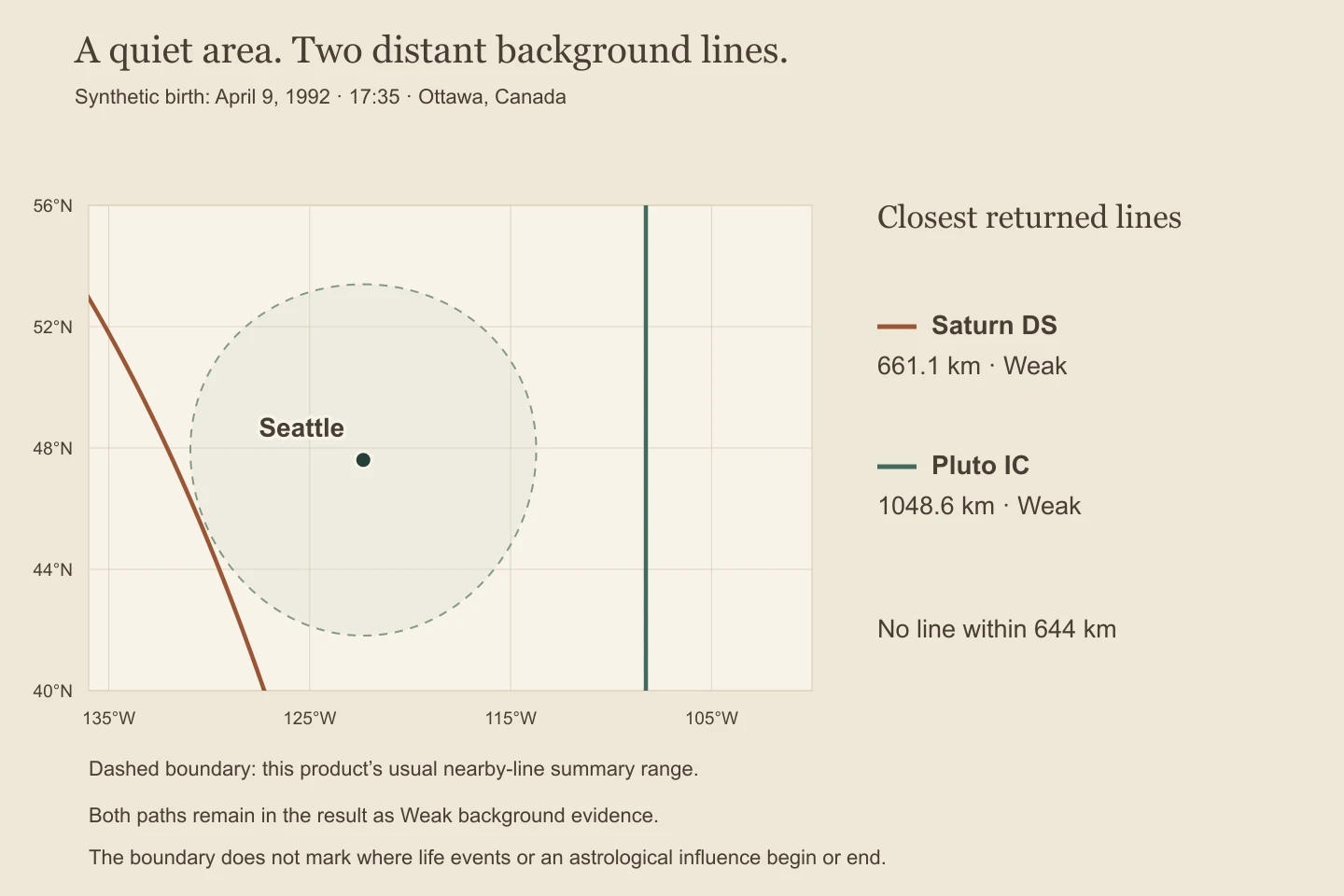
No close line is in the usual range, so these are the closest visible signals.
Saturn is the strongest visible theme here, with Pluto adding a secondary influence. Read them together rather than as a guaranteed outcome.
Notice the phrase “strongest visible theme.” Here it identifies the first of two distant items; it does not turn Saturn into a Strong proximity result. Reading the sentence without its range notice would lose the qualification that matters most for this astrocartography no lines question.
The full reading also gives a practical stay recommendation:
The map cannot reliably distinguish a short stay from long-term living here. Let work, cost, and lifestyle lead the decision.
For someone weighing a relative’s spare room against an immediate long-term commitment, that leaves the duration question open. You can understand the distant line themes without treating their presence in a written answer as a reason to sign a lease or reject the offer of a temporary base.
Seeing Saturn and Pluto may raise a more immediate concern: does this quiet-looking place secretly contain the pressure you hoped to avoid? The returned descriptions mention responsibility, intensity and change, but the distances remain part of those descriptions’ context. Two demanding planet names do not supply a personal warning about your relative’s home. The next question is whether the actual Home evidence contains a relevant caution, rather than whether a planet’s reputation sounds reassuring.
An empty display is a different answer from distant evidence
The same Seattle coordinate was calculated again with every standard planet hidden. This time the preview returns no visible line items. Its actual message is:
Turn on at least one planet line to check this city against the map.
With all ten planets visible, two distant items return; with all hidden, none returns. The birth and city have not changed. In the hidden state there is no displayed planetary evidence to interpret. In the distant state there is evidence, but its proximity is weak. A blank-looking area cannot distinguish those situations by itself.
For astrocartography no lines, establish which state belongs to your result before drawing a personal conclusion. Restoring visibility can resolve a display problem. It does not move the actual Saturn or Pluto paths closer to this city. If your result already retains distant signals, their labels and the qualified recommendation remain the relevant evidence.
Low caution. Where is the Home support?
Now keep the same synthetic birth and compare Seattle with Denver for Home. This is a selected pair, not a search across every destination. The question is whether the calculated evidence adds a reason to prefer either place as a home base. A more crowded part of the map has to answer that same question.
| City | Home support | Home caution | Returned Home support signals | Overall evidence label |
|---|---|---|---|---|
| Seattle | Weak | Low | 0 | Weak evidence |
| Denver | Weak | Moderate | 0 | Weak evidence |
Seattle’s Home support is Weak and its caution is Low. There are no selected Home support or caution signals in this result. Low caution therefore has to be read beside the empty supporting evidence. It does not establish a comfortable household, a safe neighborhood or a successful long-term move.
The full labels help explain the empty Home lists. Seattle’s Saturn DS background concerns one-to-one connection in its planet-and-angle description; that line is not selected as a Home signal here. Pluto IC does concern home and inner life, but its distance is 1,048.6 km. Recognizing a home-related label therefore still leaves a question about how that evidence is used in this particular comparison.
This saved comparison considers signals within 900 km, so that Pluto IC path is outside its analysis range. The map reading retains it as distant background instead. This explains why a named line can appear in one result while the Home caution list stays empty. The absence has a specific scope; it does not establish that every possible concern about the city has been checked.
Denver has a Jupiter AS line only 111.0 km away, labelled Strong. Yet its Home support is also Weak. The actual Home caution comes from Pluto IC at 280.7 km, with this explanation in the returned evidence:
Watch for deep emotional intensity, family pressure, or transformation around roots.
This comparison keeps two different gaps visible. Seattle lacks selected Home support and caution evidence; Denver lacks Home support but carries a specific Home caution. Neither receives a positive Home recommendation simply because the other place looks less compelling. The comparison’s actual summary says:
None of these cities shows strong goal-specific evidence in the usual comparison range. Treat the result as broad context.
For this astrocartography no lines case, Seattle has no selected support or caution signals within the Home comparison’s analysis range. The relative’s offer therefore remains a separate question: the blank area has supplied no Home reason to decline it, and the distant lines have supplied no Home reason to commit to a longer stay. Denver’s result does not resolve that gap.
Does the blank map justify turning down the spare room?
In the family-stay situation, you still need to establish what living together would involve: available space, duration, expenses and expectations. Those facts were never supplied by the empty area on the map. Seattle’s weak Home evidence leaves room for that investigation; it does not settle it in either direction. The scenario illustrates how to use the result, not a verified housing arrangement.
A useful response would be: “My Seattle map still returns Saturn DS and Pluto IC as distant background. This Home comparison selects neither support nor caution signals for Seattle. I cannot turn the blank area into a verdict about my relative’s home. Before accepting the temporary room, I need to agree what the stay would involve.” The map has clarified why the area looks quiet; the conversation with the relative addresses the actual offer.
When exploring astrocartography no lines with your own data, retain the city, visible planets and question beside the result. A Home comparison cannot borrow its answer from a Travel theme, and the ordinary-line example here does not establish what optional layers would show. Your reading may contain nearby evidence, weak background or no visible items at all.
Begin with your own birth details in the form above and bring the city you already care about into its location reading. The map, full location readings and standard comparisons are free. For proximity bands, the line distance guide explains that separate question. If your birth time is unknown, keep its estimated-time limits visible as well; displaying more lines cannot improve that input.
Read your own city’s evidenceAstrocartography no lines: questions about your own result
What does astrocartography no lines near a city mean?
First distinguish no visible lines from no nearby lines. With the standard planets visible, the latter means none is within this map’s usual 644 km summary range. The reading can still return the closest distant signals. That result offers limited local line evidence; it does not classify the city as unsuitable or prove that life there will be neutral.
Should I avoid living somewhere with no nearby lines?
The blank area alone is insufficient reason to reject a place. In the synthetic Seattle example, the Home result contains Weak support and Low caution, with no selected Home support or caution signals. It leaves the home question unresolved. Keep practical reasons for considering a city alongside the reading rather than inventing a negative verdict from missing nearby evidence.
Why do I get a written reading when both lines are Weak?
The product retains the nearest visible lines as background when none falls inside the usual range. Their planet-and-angle descriptions can still be explained. In this example, ‘strongest visible theme’ names the first of two distant signals, while both proximity labels remain Weak. Read the range notice and stay recommendation with the interpretation, not just the planet’s description.
Does Low caution mean the city is a good place to settle?
Low caution needs to be read with support and the underlying evidence. Seattle’s calculated Home caution is Low, but its Home support is Weak and its selected Home signal lists are empty. This is an evidence gap, not a positive recommendation for settling there. It also does not assess safety, housing, employment or your family’s preferences.
Is the 644 km range a boundary for what I can experience?
No. It organizes this product’s nearby-line summary. A line just outside it does not disappear: Seattle still returns Saturn DS at 661.1 km as weak background. The range is not a proven boundary for events or a reason to treat a small distance difference as a complete change in a city’s meaning.
Can astrocartography no lines be caused by my map settings?
Yes. When every standard planet is hidden, the same Seattle coordinate returns no visible lines and no line items. That differs from the all-visible example, which returns two distant items. Restore the planetary lines you intend to read before interpreting an empty result. An unknown birth time is a separate issue: its estimated input remains uncertain even when lines are displayed.